A loose piece gets three chances to show up. Each one is shown here on a position from a real game.
1Tunnel Vision: a piece that was already attacked
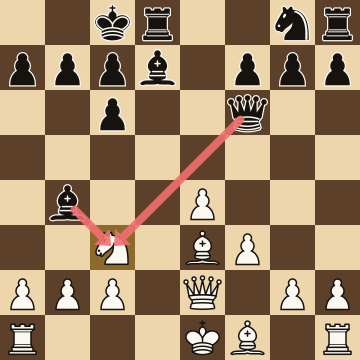
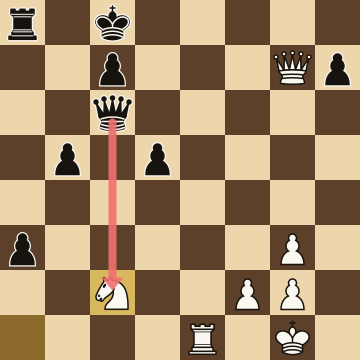
Diagram 1 · White to play
Tunnel Vision is the hung piece you never moved. Your opponent already threatened something, and your move didn't deal with it, usually because you were busy with your own plan.
The position. White to play, move 10, from a real game on Lichess. Black's bishop on b4 pins the knight on c3 to the king, and Black's queen on f6 attacks it too. Two attackers, one defender.
The move. White took the pawn on a7 (Bxa7).
What it cost. Black took the knight with check, Bxc3+, and after bxc3 the queen took again on c3, with check, hitting the rook on a1, which falls next. White lost the knight, a pawn and the rook, for a bishop and the pawn on a7.
Better. Qd2, defending the knight.
How to check
When your opponent moves, name what the moved piece attacks now, and what it uncovered behind it.
Find any piece of yours that is attacked more times than it is defended, and play the captures through to see whether it really falls.
Only then go back to your own plan.
Where it hides
A pin. The attacked piece can't step away, like the knight on c3, pinned to the king.
A second attacker. One more attacker can make a defended piece hang, like the knight on c3 once the bishop and the queen both hit it. Play the captures through before you call it safe.
A discovered attack. The piece that moves isn't the one that attacks; the line it opens is.
In the app. When Tunnel Vision keeps showing up in your games, it gets a training stage of its own, with its question on it.
2Hung a Piece: a square you didn't count
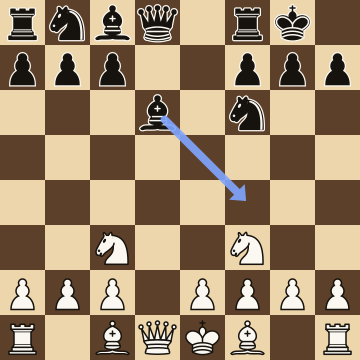
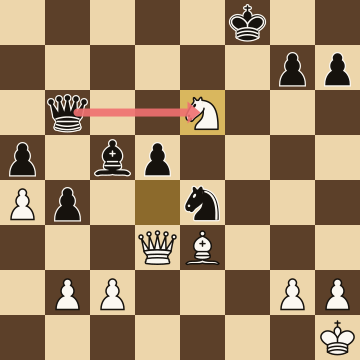
Diagram 2 · White to play
Hung a Piece is the piece you just moved. You put it on a square where it can be taken, or where the trade loses it.
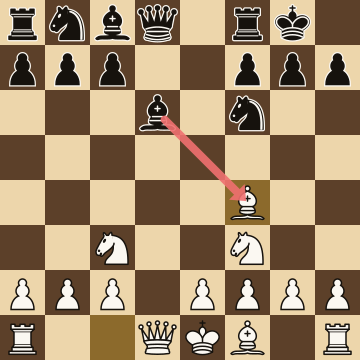
The position. White to play, move 6, from a real game on Lichess. Black's bishop on d6 looks down the diagonal to f4.
The move. Bf4, a normal-looking developing move.
What it cost. Black took it, Bxf4, and nothing takes back. After the queens came off (Qxd8 Rxd8), White was a bishop down.
Better. Nb5, which attacks the bishop on d6.
How to check
Before you let go of the piece, count your opponent's pieces that attack its new square, and yours that defend it.
More attackers than defenders is a warning, not yet a loss. Play the captures through in your head, cheapest piece first, and add up what each side gives. If the cheapest attacker is worth less than your piece, it's lost even when it's defended.
Check what the piece guarded on the square it left.
Where it hides
Long lines. Bishops, rooks and queens attack from across the board, like the bishop on d6 aiming at f4.
A defender that can't defend. It's pinned, or it already guards something else.
An x-ray. A piece behind another on the same line joins in once the one in front leaves the line, for example by taking first. Count it only if the captures really clear the way.
In the app. The same kind of stage as Tunnel Vision, with its question on it.
3Hope Chess: a reply you didn't look at
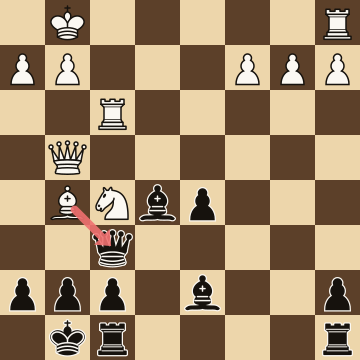
Diagram 3 · Black to play
The name comes from chess teacher Dan Heisman. Hope chess is playing a move without checking whether you can meet every check, capture and threat it allows, and hoping your opponent doesn't find the reply. Many coaches teach its question as "checks, captures, threats", for both sides, before every move.
The position. Black to play, move 17, from a real game on Lichess. White's bishop on g5 attacks Black's queen.
The move. Qg6: the queen steps out of the attack.
What it cost. White had a check first: Ne7+ hits the king and the queen together. After Kh8, Nxg6+ takes the queen.
Better. Bxf5, taking the knight that would make the fork, and attacking White's queen in return.
How to check
Pick your move, and before you play it, look at the board from your opponent's side.
List every check they would have, even the ones that look silly. Then every capture, then every threat.
If one of them wins something, pick another move.
Where it hides
A fork with check. A knight check that hits the king and the queen together, like Ne7+.
A safe-looking square. The queen stepped out of one attack onto g6, where a knight check on e7 hits it too.
The piece you didn't take. The knight on f5 made the fork possible; taking it first, Bxf5, removed it.
In the app. Hope Chess has no stage of its own. The app trains the habit behind your move instead, such as Tunnel Vision or Hung a Piece.
Which one is yours?
One game shows one hung piece. Side by side, last week's loose knight and today's lost bishop turn out to be the same habit. Blunders don't stop at any rating, as our data in At what Elo do you stop blundering? shows, but a habit you can name is one you can train.
3 times in 3 games
Hung a Piece
Hung a Piece is the piece you just moved. You put it on a square where it can be taken, or where the trade loses it.
Better at Chess reads your recent Chess.com or Lichess games, checks every move with a chess engine and sorts each mistake into a named habit with a count. Then it trains the one that costs you most, on positions from your own games.
Stage · Hung a Piece
“Before you put a piece on a square, count its attackers and defenders there.”
Your positionsFrom your games
PuzzlesOne move looks tempting. Find a better one.
Because of a habit more than a gap in knowledge. You were busy with your own plan and missed what your opponent's last move attacked, you moved a piece without counting the square, or you didn't check the replies your move allowed. Each one looks like a new mistake every time, so it's hard to see it coming back.
How do I avoid hanging pieces in fast games?
The same three questions, asked faster. In blitz, at least ask the first one on every move: what did my opponent's last move attack?
Do puzzles help me stop hanging pieces?
Puzzles train you to spot tactics. Puzzles drawn from your own habit, where one move looks tempting and you have to find a better one, practise the exact moment you keep getting wrong.
Is there an app that shows which mistakes I keep making?
Yes. Better at Chess, for iPhone, reads your recent Chess.com or Lichess games, sorts every mistake into a named habit and counts it, then trains the habits that cost you most. Get it on the App Store.
What does it cost?
Your chess profile shows the habits your own games repeat most. A subscription adds your training, Progress, Games and Review: 7 days free, then $59.99 a year, or $8.99 a month without a trial.
See which one you keep doing
Link your Chess.com or Lichess username, and your chess profile is ready once your games are read.
Your chess profileThe habits your games repeat most